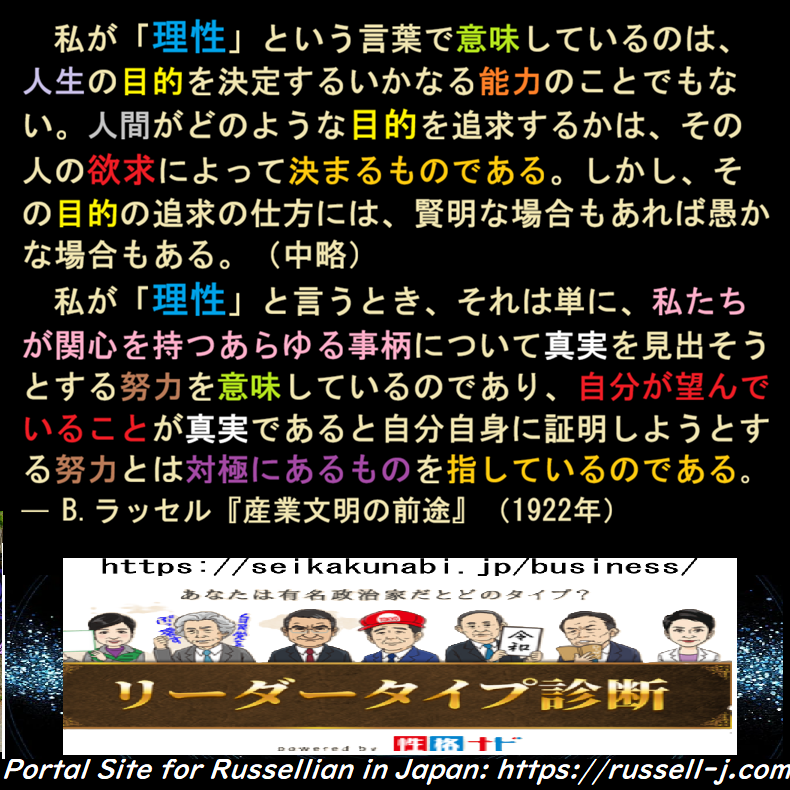
私が「理性」という言葉で意味しているのは、人生の目的を決定するいかなる能力のことでもない。人間がどのような目的を追求するかは、その人の欲求によって決まるものである。しかし、その目的の追求の仕方には、賢明な場合もあれば愚かな場合もある。(中略)
私が「理性」と言うとき、それは単に、私たちが関心を持つあらゆる事柄について真実を見出そうとする努力を意味しているのであり、自分が望んでいることが真実であると自分自身に証明しようとする努力とは対極にあるものを指しているのである。
-- B.ラッセル『産業文明の前途』(1922年
The meaning of "reason"
I do not mean by "reason" any faculty of determining the ends of life. The ends which a man will pursue are determined by his desires; but he may pursue them wisely or unwisely. ... When I speak of "reason," I mean merely the endeavor to find out the truth about any matter with which we are concerned, as opposed to the endeavor to prove to ourselves that what we desire is true.
Source: The Prospects of Industrial Civilization, 1922, by Bertrand Russell
<寸言:ラッセルに学ぶ「理性的」な政治家の見分け方>
「あの政治家は理性的だ」「いや、感情的すぎる」……私たちはよくそんな会話をしますが、そもそも「理性的」とはどういう意味でしょうか。
バートランド・ラッセルは、1922年の著書『産業文明の前途』の中で、目からウロコが落ちるような定義を残しています。
私が「理性」という言葉で意味しているのは、人生の目的を決定するいかなる能力のことでもない。人間がどのような目的を追求するかは、その人の欲求によって決まるものである。しかし、その目的の追求の仕方には、賢明な場合もあれば愚かな場合もある。(中略)「理性」はナビ、でも「目的地」は選べないb
私が「理性」と言うとき、それは単に、私たちが関心を持つあらゆる事柄について真実を見出そうとする努力を意味しているのであり、自分が望んでいることが真実であると自分自身に証明しようとする努力とは対極にあるものを指しているのである。 -- B.ラッセル『産業文明の前途』(1922年)
ラッセルに言わせれば、理性とは「どこへ行きたいか(目的)」を決めるものではありません。それは私たちの内なる「欲求」が決めること。理性の役割は、その目的地にたどり着くための**「正しい地図(真実)及びルート」**を見つけ出すことなのです。
一番怖いのは、「自分の行きたい方向が正しいはずだ!」と思い込むあまり、地図を自分に都合よく書き換えてしまうこと。 これをラッセルは「非理性的」だと断じました。
この視点で現代の政治家を眺めてみると、4つのタイプが見えてきます。
政治家の4タイプ・マトリックス
【哲人政治家 / 賢者】(情熱:高 × 理性:高)
高い理想(善い情熱)を持ちながら、それを実現するために「不都合なデータ」も冷徹に見つめるタイプ。理想と現実のバランスが取れた、ラッセルが望んだ姿です。
【マキャベリスト / 冷徹な戦略家】(情熱:高 × 理性:高 ※ただし私欲)
目的が「権力維持」などの私欲であっても、手段の選択において極めて客観的でミスをしないタイプ。敵に回すと恐ろしいですが、予測可能な分、まだ扱いようがあります。
【教条主義者 / 狂信者】(情熱:高 × 理性:低)
「自分こそが正しい」という信念(願望)が強すぎて、現実を無視して突っ走るタイプ。プーチンのような独裁者が、もし「戦況は順調だ」という願望思考に陥っているなら、まさにここ。信念型の政治家も、客観的事実を軽視し始めればこのリスクを孕みます。
【日和見主義者 / 風見鶏】(情熱:低 × 理性:低)
実は一番困るのがこのタイプ。 「何を成し遂げたいか」という情熱もなく、かといって「何が真実か」を深く探究する知性もない。ただその場の空気に流されるだけの政治家です。
私たちが今、求めるべきもの
ラッセルの言葉を借りれば、優れたリーダーとは「熱い心(欲求)」と「冷徹な目(理性)」を分離できている人のことです。
「自分がこうあってほしい」と思う世界と、「現実のデータ」が食い違ったとき、どちらを優先するか? そこで潔く現実を直視し、目的地までのルートを修正できる誠実さ。それこそが、ラッセルが言うところの真の「理性」なのだと思います。
みなさんの支持する政治家は、今、どの位置に座っているでしょうか?
How to Identify a "Rational" Politician: Lessons from Bertrand Russell
"That politician is rational," or "No, they’re far too emotional." We often hear these kinds of remarks, but what does it actually mean to be "rational"?
In his 1922 book, The Prospects of Industrial Civilization, Bertrand Russell provides an eye-opening definition that remains remarkably relevant today.
"I do not mean by 'reason' any faculty of determining the ends of life. The ends which a man will pursue are determined by his desires; but he may pursue them wisely or unwisely. ... When I speak of 'reason,' I mean merely the endeavor to find out the truth about any matter with which we are concerned, as opposed to the endeavor to prove to ourselves that what we desire is true."
-- Bertrand Russell, The Prospects of Industrial Civilization (1922)
Reason is the Navigation, Not the Destination
According to Russell, reason does not decide "where we want to go" (our goals). That is determined by our inner "desires." The role of reason is to find the correct map (truth) and the best route to reach that destination.
The most dangerous thing a person can do is to become so convinced that "my direction must be right" that they rewrite the map to suit their convenience. This is exactly what Russell condemned as being "irrational."
When we look at modern politicians through this lens, four distinct types emerge.
The Four-Type Matrix of Politicians
The Philosopher-Statesman / The Sage (High Passion × High Reason)
Driven by high ideals (good passion), yet capable of staring coldly at "uncomfortable data" to make them a reality. This balance of idealism and realism is the figure Russell hoped for.
The Machiavellian / The Cold Strategist (High Passion × High Reason but driven by self-interest) Even if their goal is purely selfish?such as maintaining power?they are extremely objective and precise in their choice of means. They are formidable enemies, but because they are rational, they are at least predictable.
The Dogmatist / The Fanatic (High Passion × Low Reason)
Driven by such a strong belief (desire) that "I am right" that they ignore reality and charge ahead. If a dictator like Putin falls into the wishful thinking that "the war is going well," he fits here. Even well-intentioned, conviction-led politicians run this risk the moment they stop respecting objective facts.
The Opportunist / The Weathercock (Low Passion × Low Reason)
Actually, this is the most problematic type. They have no inner passion for what they want to achieve, nor do they have the intellectual depth to seek out the truth. They are politicians who simply drift wherever the wind of public opinion blows.
What We Should Seek Today
To borrow Russell’s perspective, an exceptional leader is someone who can separate their "hot heart" (desire) from their "cool eye" (reason).
When the world as you wish it to be clashes with the "actual data," which do you prioritize? Having the integrity to look reality in the face and adjust the route to the destination?that, I believe, is the essence of true "reason" as Russell described it.
Where on this matrix does the politician you support sit today?
ラッセル関係電子書籍一覧ラッセル関係電子書籍一覧
#バートランド・ラッセル #Bertrand_Russell