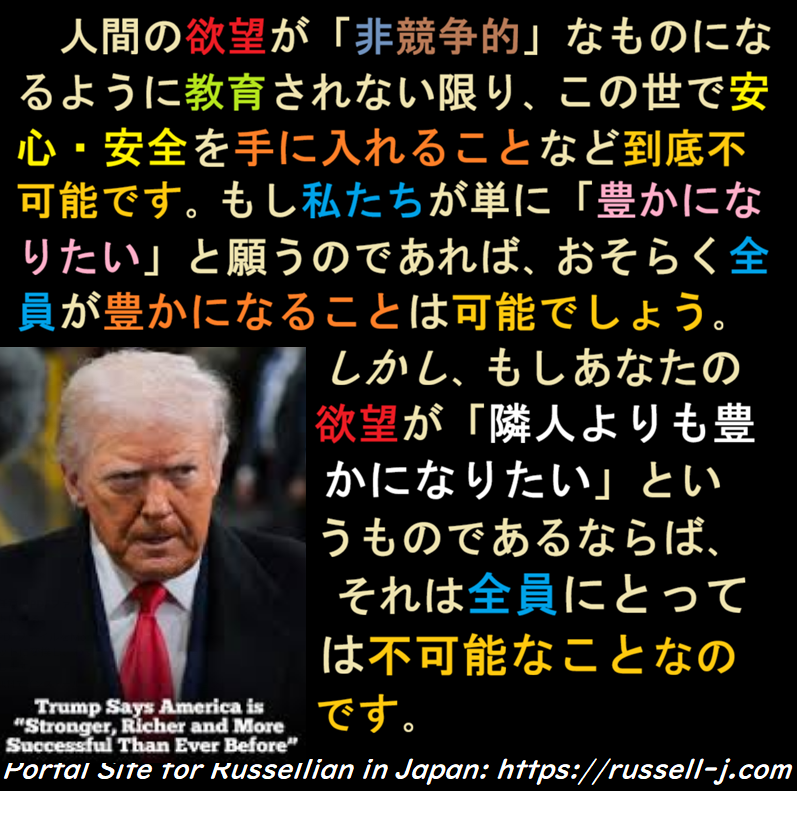
人間の欲望が「非競争的」なものになるように教育されない限り、この世で安心・安全を手に入れることなど到底不可能です。もし私たちが単に「豊かになりたい」と願うのであれば、おそらく全員が豊かになることは可能でしょう。しかし、もしあなたの欲望が「隣人よりも豊かになりたい」というものであるならば、それは全員にとっては不可能なことなのです。
-- B.ラッセル『安心・安全は増しているか?』(1939年に行われたラジオ討論番組)
The Desire to Be "Richer Than One's Neighbor"
You cannot possibly get security in the world unless people are so educated that their desires will be non-competitive. If we desire to be rich, we could conceivably all be rich; but if your desire is to be richer than your neighbor, that is impossible for everybody.
Source: s security increasing?; radio discussion with Albert G. Hart & W. H. C. Laves.
* The Univ. of Chicago Round Table, 15 Jan. 1939.(published as a pamphlet in 1939)
<寸言:「隣人よりも豊かになりたい」という欲望>
バートランド・ラッセルは、1939年のラジオ討論において次のように述べています。
「人間の欲望が『非競争的』なものになるように教育されない限り、この世で安心・安全を手に入れることなど到底不可能です。もし私たちが単に『豊かになりたい』と願うのであれば、おそらく全員が豊かになることは可能でしょう。しかし、もしあなたの欲望が『隣人よりも豊かになりたい』というものであるならば、それは全員にとっては不可能なことなのです。」(Is security increasing?, 1939)他人を傷つけないで、世の中にないものを生みだすための競争であればよいことですが、限りあるもの(資源、地位、権力、その他)を奪い合う競争は、利益以上の弊害を生み出してしまいます。人間の欲望には限りはなく、昔に比べればかなり生活が改善されてはいますが、隣人(自分が親しい人)よりも自分(あるいは自分の家族)がかなり見劣りするということがわかれば、満足感は消え、多くの人が不幸な心理状態に陥ってしまいます。現代社会において、生活水準そのものは向上しても、SNSなどで他人の生活が可視化されることで、かえってこの「比較による不幸」が増幅されているようにも感じられます。
同様の趣旨の発言を、ラッセルはいろいろなところでしています。『ラッセル幸福論』を読んだことのある人なら、次の記述を覚えておられると思います。
「それゆえ、人びとが生存競争という言葉で意味しているのは、実際は、成功のための競争にほかならない。この競争に参加しているとき、人びとが恐れているのは、明日の朝食にありつけないのではないかということではなくて、隣人に勝ることができないのではないか、ということである。」(The Conquest of Happiness, 1930)ここでラッセルが指摘しているのは、現代人の「生存競争」の正体が、実は生存そのものではなく「相対的な優越」をめぐる争いにすり替わっているという皮肉です。
さらに、彼の思想を象徴するのが、人間の衝動を二つに分けた次の有名な一節です。
「この二種類の物に対応して、二種類の衝動があります。即ち、共有しえない物を入手したり、保有したりしようとする『所有衝動』と、隠したりまたは私有する必要のないものをこの世の中にもたらしたいという『創造衝動』です。・・・(そうして)最善の人生とは、創造的衝動が最大限に発揮され、所有衝動が最小限に現れる人生です。」(Principles of Social Reconstruction, 1916) 「所有」は誰かから奪うことでしか満たされない「競争的」なものですが、「創造」は誰の取り分も減らさずに価値を分かち合える「非競争的」なものです。私たちが真の「安心・安全」を手に入れるためには、この所有の呪縛から解き放たれ、創造的な生き方へと向かうような教育と価値観の転換が必要なのではないでしょうか。
The Desire to Be "Richer Than One's Neighbor"
In a 1939 radio discussion, Bertrand Russell made the following observation:
"You cannot possibly get security in the world unless people are so educated that their desires will be non-competitive. If we desire to be rich, we could conceivably all be rich; but if your desire is to be richer than your neighbor, that is impossible for everybody." -- (Is security increasing?, 1939)Competition can be a force for good when it involves creating something new without harming others. However, competition centered on scrambling for limited resources?such as wealth, status, or power?often produces more harm than benefit. While human desires are boundless and our standard of living has improved significantly compared to the past, a sense of satisfaction quickly vanishes the moment we realize that we (or our families) appear "inferior" to our neighbors or those close to us. This realization plunges many into a state of unhappiness.
Russell expressed similar sentiments throughout his works. Those who have read The Conquest of Happiness may recall the following passage:
"What people mean, therefore, by the struggle for life is really the struggle for success. What people fear when they engage in the struggle is not that they will fail to get their breakfast next morning, but that they will fail to outshine their neighbours." -- (The Conquest of Happiness, 1930)Here, Russell points out the irony that what modern people call a "struggle for life" is not actually about survival, but rather a contest for relative superiority.
Perhaps his most famous articulation of this idea is his distinction between two types of human impulses:
"There are two kinds of impulses, corresponding to these two kinds of goods. There are 'possessive' impulses, which aim at acquiring or retaining goods that cannot be shared... and there are 'creative' impulses, which aim at bringing into the world goods which there is no need to hide or keep for oneself... The best life is the one in which the creative impulses play the largest part and the possessive impulses the smallest."? (Principles of Social Reconstruction, 1916)While "possession" is inherently competitive?often requiring one to take from another?"creation" is non-competitive, allowing us to share value without diminishing anyone else's share. To truly achieve a sense of security in our lives, we may need a shift in education and values?one that liberates us from the obsession with possession and directs us toward a more creative way of living.
 ラッセル関係電子書籍一覧 |
 ラッセル関係電子書籍一覧
#バートランド・ラッセル #Bertrand_Russell