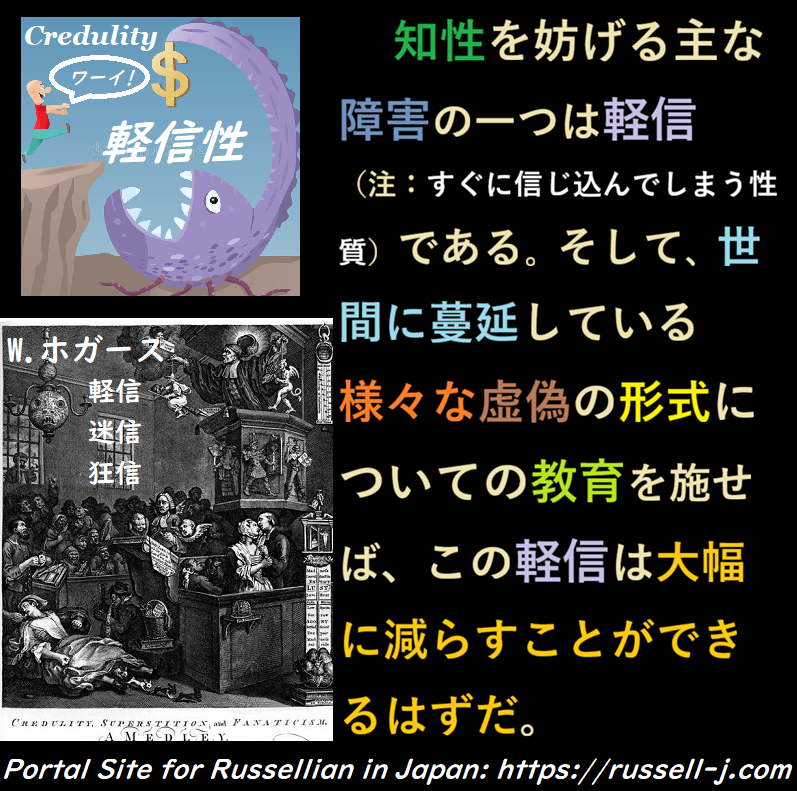
Bertrand Russell: Free Thought and Official Propaganda, 1922, p.52. Reprinted in: Sceptical Essays, 1928, chapter 12.
寸言:思考力を養うための教育 ―― 「言葉の表現形式(レトリック)」を教材にする
知性を妨げる最大の障害は、根拠もなく信じ込んでしまう「軽信性」です。バートランド・ラッセルは、この軽信を減らすためには、世に蔓延する「嘘」そのものだけでなく、それらがどのような**「言葉の表現形式(レトリック)」**を用いて届けられているかを教えるべきだと説きました。私たちは日常的に「嘘・偽り」をセットで使いますが、この二つには戦略的な違いがあります。
嘘(Lies):発言内容と事実の不一致(単純なデタラメ)。
偽り(Deception):言葉の選び方や態度によって、自分を実態以上に価値あるものに見せかける「表現の枠組み」そのもの。
2月8日の投開票に向けた「未来投資解散」の熱狂の中で、私たちはこの「レトリック」を精査する知性を持たねばなりません。
事例分析:高市首相の言説に見る「表現形式」の変遷
01:権威を偽装するレトリック(米連邦議会立法調査官) 公式プロフィールに長年記された「立法調査官」という肩書き。実際は松下政経塾の研修生(Congressional Fellow)でしたが、専門用語という「言葉の表現形式」を借りることで、実態以上の権威を国民に植え付けました。これはラッセルが警告する、形式による欺瞞の典型例です。
02:断定とレッテル貼りのレトリック(放送法「捏造」答弁) 総務省の内部文書を「捏造」と言い切った姿勢。内容の真偽を検証する前に、強い言葉の形式で相手を否定することで、聴衆の思考を停止させ、自身の正当性を信じ込ませる手法です。総理となった今、反対勢力に対して同様のレトリックが繰り返されていないか注意が必要です。
03:変節を隠蔽するレトリック(2025年 台湾有事・靖国参拝) 2025年11月の台湾有事を巡る「軍事介入」を示唆する発言と、その後の「政府方針内」とする釈明。また、総裁選での靖国参拝公約が、総理就任後に「適切な判断」という曖昧な形式へと変化したこと。これらは、自身の本音と現実の乖離を「言葉の表現形式」で塗りつぶす行為と言えます。
04:期待を煽るレトリック(2026年1月「未来投資解散」) 今回の解散を「未来投資」と名付けたこと自体が、極めて巧妙なレトリックです。過去の公約撤回(食料品非課税の断念など)への批判を、ポジティブな響きを持つ「未来」という言葉の形式にすり替えることで、国民の「軽信」を誘っています。
結び
「かつて何を言ったか」と「今何を言っているか」を、言葉の飾り(レトリック)を剥ぎ取って照らし合わせること。評価の定まった記録を素材に、こうした情報の乖離を精査する習慣こそが、現代のプロパガンダに抗うための真の教育になります。
2月8日、私たちは「言葉の響き」に投じるのか、それとも「事実の積み重ね」に投じるのか。ラッセルの鋭い警告が、今ほど重く響く時はありません。
Short Essay: Education for Developing Thinking Skills ? Analyzing the "Rhetorical Forms of Language"
One of the chief obstacles to intelligence is credulity (the tendency to believe things too easily without evidence). Bertrand Russell argued that this credulity could be enormously diminished by providing instruction on the prevalent "rhetorical forms of language" used to convey falsehoods.
While we often use the terms "lies" and "deception" interchangeably, there is a strategic nuance between them that we must distinguish:
Lies: Simple factual inaccuracies or blatant falsehoods.
Deception (Mendacity): A deeper form of manipulation where one’s attitude or framing makes oneself appear more credible or virtuous than the reality suggests.
As we approach the "Future Investment Dissolution" general election on February 8th, the current political climate under Prime Minister Takaichi serves as a critical "textbook" for testing our collective intelligence.
Case Analysis: Examining the "Rhetorical Forms" of PM Takaichi
01: Rhetoric of Counterfeit Authority (The Congressional Fellow Issue) For years, her official profile listed her as a "Congressional Investigator." In reality, she was a "Congressional Fellow" (trainee) from the Matsushita Institute. By borrowing the rhetorical form of a professional title, she instilled an exaggerated sense of authority in the public mind. This is a classic example of what Russell warned against: deception through formal framing.
02: Rhetoric of Categorical Denial (The Broadcasting Act "Fabrication" Case) Her definitive assertion that internal Ministry of Internal Affairs documents were "fabrications" is a key example. By using a powerful rhetorical form to label and dismiss opposition before a factual verification could occur, she effectively halts the audience’s critical thinking, inducing them to believe in her own legitimacy.
03: Rhetoric of Concealing Inconsistency (Taiwan Emergency & Yasukuni Visits, 2025) Her November 2025 remarks suggesting military intervention in a Taiwan emergency, followed by a later clarification that it was "within government policy," show a pattern of shifting. Similarly, her campaign pledge to visit the Yasukuni Shrine evolved into the ambiguous rhetorical form of "making an appropriate judgment" after taking office. These acts use language to mask the gap between personal conviction and political reality.
04: Rhetoric of Evoking Expectation (January 2026 "Future Investment Dissolution") The naming of the current dissolution as "Future Investment" is a highly sophisticated rhetorical maneuver. By rebranding the election with the positive rhetorical form of "the future," she attempts to reset and obscure past criticisms?such as the abandonment of tax-free food pledges?and entice the public back into a state of "credulity."
Conclusion
To compare what was said in the past with what is being said now?stripping away the decorative rhetoric?is the fundamental basis of logical thinking. Developing the habit of scrutinizing these informational discrepancies using historical records is the only true education that can protect us from modern propaganda.
On February 8th, will we vote for the "sound of words," or the "accumulation of facts"? Russell’s sharp warning has never resonated more deeply than it does today.
 ラッセル関係電子書籍一覧 |
 ラッセル関係電子書籍一覧
#バートランド・ラッセル #Bertrand_Russell