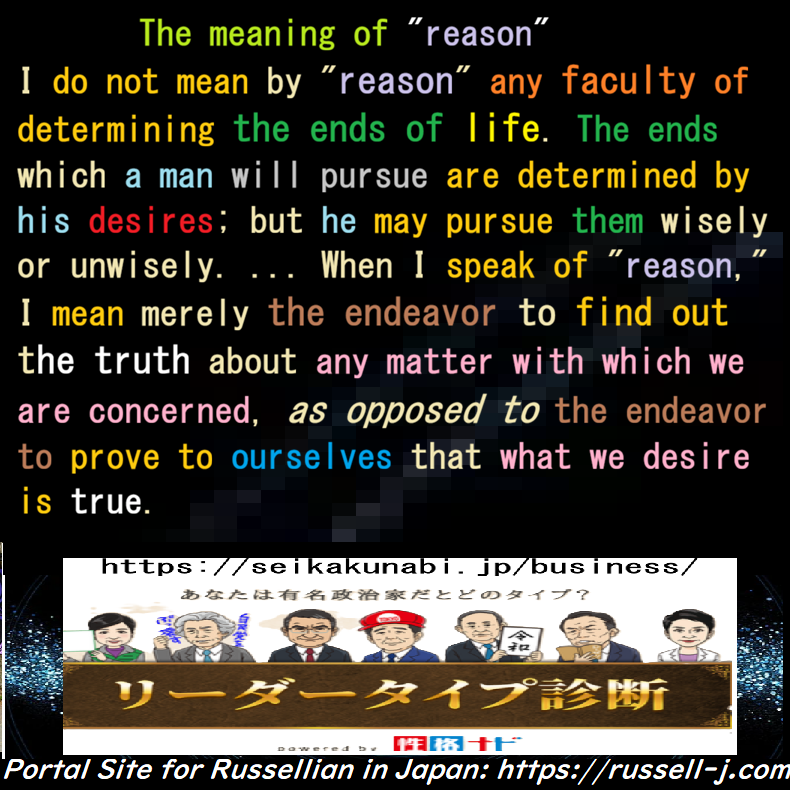
The meaning of "reason"
I do not mean by "reason" any faculty of determining the ends of life. The ends which a man will pursue are determined by his desires; but he may pursue them wisely or unwisely. ... When I speak of "reason," I mean merely the endeavor to find out the truth about any matter with which we are concerned, as opposed to the endeavor to prove to ourselves that what we desire is true.
Source: The Prospects of Industrial Civilization, 1922, by Bertrand Russell
How to Identify a "Rational" Politician: Lessons from Bertrand Russell
"That politician is rational," or "No, they’re far too emotional." We often hear these kinds of remarks, but what does it actually mean to be "rational"?
In his 1922 book, The Prospects of Industrial Civilization, Bertrand Russell provides an eye-opening definition that remains remarkably relevant today.
"I do not mean by 'reason' any faculty of determining the ends of life. The ends which a man will pursue are determined by his desires; but he may pursue them wisely or unwisely. ... When I speak of 'reason,' I mean merely the endeavor to find out the truth about any matter with which we are concerned, as opposed to the endeavor to prove to ourselves that what we desire is true."
-- Bertrand Russell, The Prospects of Industrial Civilization (1922)
Reason is the Navigation, Not the Destination
According to Russell, reason does not decide "where we want to go" (our goals). That is determined by our inner "desires." The role of reason is to find the correct map (truth) and the best route to reach that destination.
The most dangerous thing a person can do is to become so convinced that "my direction must be right" that they rewrite the map to suit their convenience. This is exactly what Russell condemned as being "irrational."
When we look at modern politicians through this lens, four distinct types emerge.
ラッセル関係電子書籍一覧ラッセル関係電子書籍一覧
#バートランド・ラッセル #Bertrand_Russell