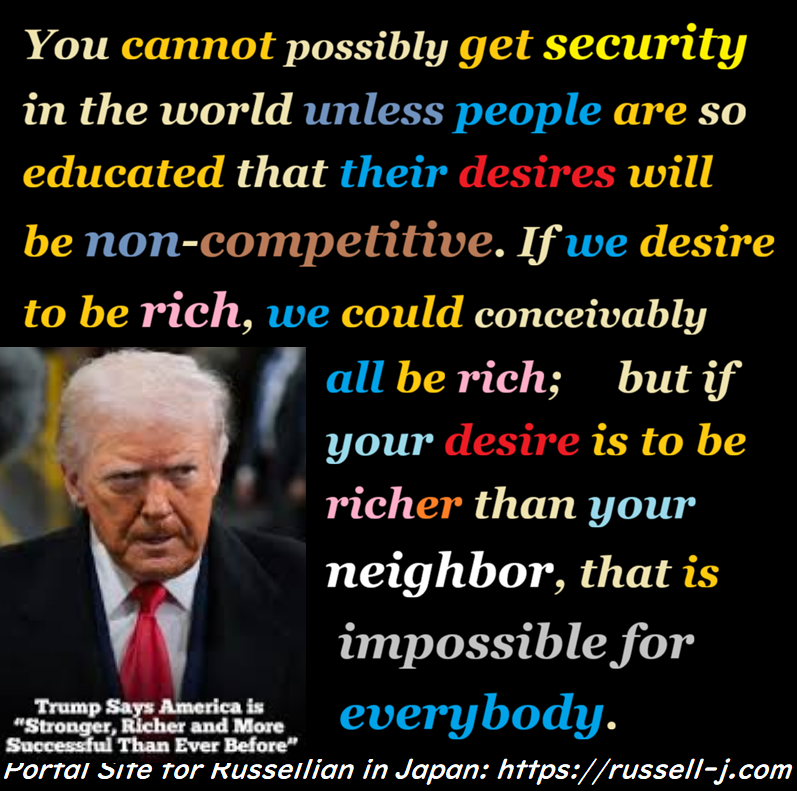
You cannot possibly get security in the world unless people are so educated that their desires will be non-competitive. If we desire to be rich, we could conceivably all be rich; but if your desire is to be richer than your neighbor, that is impossible for everybody.
Source: s security increasing?; radio discussion with Albert G. Hart & W. H. C. Laves.
* The Univ. of Chicago Round Table, 15 Jan. 1939.(published as a pamphlet in 1939)
The Desire to Be "Richer Than One's Neighbor"
In a 1939 radio discussion, Bertrand Russell made the following observation:
"You cannot possibly get security in the world unless people are so educated that their desires will be non-competitive. If we desire to be rich, we could conceivably all be rich; but if your desire is to be richer than your neighbor, that is impossible for everybody." -- (Is security increasing?, 1939)Competition can be a force for good when it involves creating something new without harming others. However, competition centered on scrambling for limited resources?such as wealth, status, or power?often produces more harm than benefit. While human desires are boundless and our standard of living has improved significantly compared to the past, a sense of satisfaction quickly vanishes the moment we realize that we (or our families) appear "inferior" to our neighbors or those close to us. This realization plunges many into a state of unhappiness.
Russell expressed similar sentiments throughout his works. Those who have read The Conquest of Happiness may recall the following passage:
"What people mean, therefore, by the struggle for life is really the struggle for success. What people fear when they engage in the struggle is not that they will fail to get their breakfast next morning, but that they will fail to outshine their neighbours." -- (The Conquest of Happiness, 1930)Here, Russell points out the irony that what modern people call a "struggle for life" is not actually about survival, but rather a contest for relative superiority.
Perhaps his most famous articulation of this idea is his distinction between two types of human impulses:
"There are two kinds of impulses, corresponding to these two kinds of goods. There are 'possessive' impulses, which aim at acquiring or retaining goods that cannot be shared... and there are 'creative' impulses, which aim at bringing into the world goods which there is no need to hide or keep for oneself... The best life is the one in which the creative impulses play the largest part and the possessive impulses the smallest."? (Principles of Social Reconstruction, 1916)While "possession" is inherently competitive?often requiring one to take from another?"creation" is non-competitive, allowing us to share value without diminishing anyone else's share. To truly achieve a sense of security in our lives, we may need a shift in education and values?one that liberates us from the obsession with possession and directs us toward a more creative way of living.
 ラッセル関係電子書籍一覧 |
 ラッセル関係電子書籍一覧
#バートランド・ラッセル #Bertrand_Russell