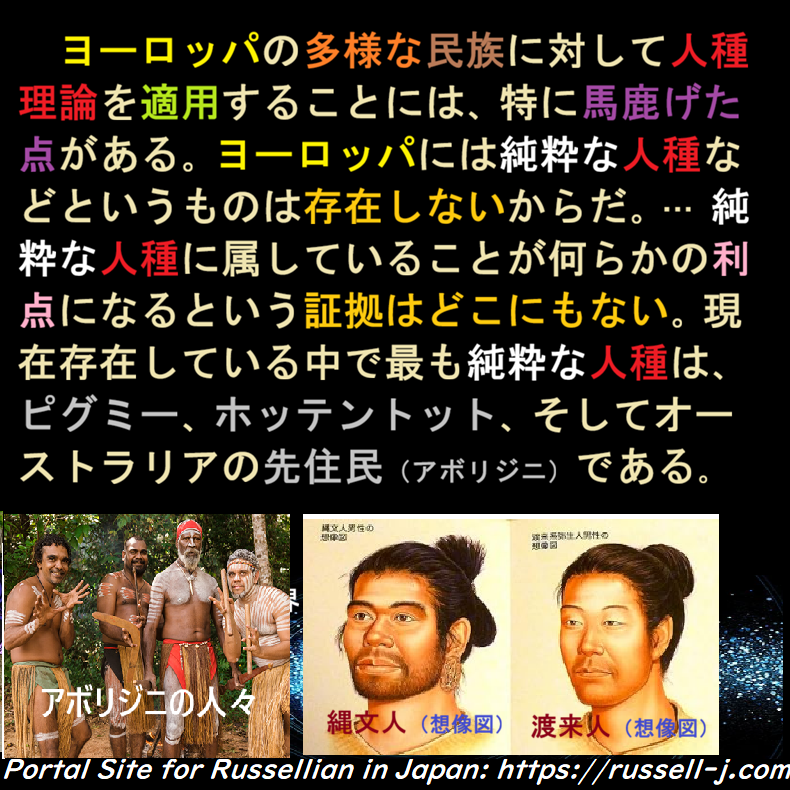
ヨーロッパの多様な民族に対して人種理論を適用することには、特に馬鹿げた点がある。ヨーロッパには純粋な人種などというものは存在しないからだ。……純粋な人種に属していることが何らかの利点になるという証拠はどこにもない。現在存在している中で最も純粋な人種は、ピグミー、ホッテントット、そしてオーストラリアの先住民(アボリジニ)である。(There is a special absurdity in applying racial theories to the various populations of Europe. There is not in Europe any such thing as a pure race. ... There is no evidence that there is any advantage in belonging to a pure race. The purest races now in existence are the Pygmies, the Hottentots, and the Australian aborigines;...
Source: An Outline of Intellectual Rubbish, 1943, by Bertrand Russell)
<「人種的な純粋性」という幻想:ラッセルの警告と現代日本>
バートランド・ラッセルは、その著書『知的なくだらなさの概略(1943年)』の中で、人種理論の欺瞞を次のように喝破しています。
「ヨーロッパの多様な民族に対して人種理論を適用することには、特に馬鹿げた点がある。ヨーロッパには純粋な人種などというものは存在しないからだ。・・・。純粋な人種に属していることが何らかの利点になるという証拠はどこにもない。現在存在している中で最も純粋な人種は、ピグミー、ホッテントット、そしてオーストラリアの先住民である。・・・。たとえば、古代ギリシャ人は、北方の野蛮人と先住民が混血することで誕生した。つまり、最も文明的であったアテネ人やイオニア人は、同時に最も混血が進んだ人々でもあったのである。人種の純粋さがもたらすとされる利点などは、どうやら全くの幻想にすぎないようである。」日本における「純粋性」を問い直す
私たちは「日本人は島国に住んでいるため、他民族に比べ人種的な純粋性が高い」と語る場面にしばしば遭遇します。しかし、それはあくまで相対的な印象に過ぎず、現代の科学的・歴史的事実を照らし合わせると、次のような点を考慮する必要があります。
1.ゲノムの「三重構造」モデル: 現代日本人は、狩猟採集民の「縄文人」と、大陸から稲作をもたらした「渡来系弥生人」の混血に加え、古墳時代に流入した「渡来人」の影響を受けたという「三重構造」モデルが、最新の全ゲノム解析により主流となっている。
2.氷河期による陸続きの歴史: 日本列島が大陸から分離したのは約1,500万年前であるが、その後も氷河期(特に約2万年前の最終氷期最盛期など)には海水面が低下し、中国大陸や朝鮮半島と陸続きになっていた。
3.絶え間ない流入と混血: 日本における最後の氷河期が約1万年前に終了するまで(あるいは終了後も)、列島は完全に閉ざされた環境ではなく、絶えずヒトと文化の流入が続く「混血の場」だった。
ここで注目すべきは、ラッセルが「純粋な人種」の例としてピグミーやアボリジニを挙げている点です。彼らが「純粋」であり得たのは、物理的に外部との交流が長期間遮断されていたからに他なりません。対照的に、人類史に燦然と輝くギリシャ文明が「最も混血が進んだ人々」によって築かれたという事実は、人種の純粋さが文明の質を保証するものではないことを如実に物語っています。
以上の事実を前提とした場合、もし日本民族の「純粋性」を主張するならば、こうした科学的・歴史的事実をどう捉えているのか、またその主張の具体的な根拠は何なのかを明らかにすべきでしょう。「純粋さ」という実体のない幻想に固執するのではなく、多様なルーツが混じり合うことで独自の文化を育んできた歴史を直視することこそが、偏狭な民族主義に陥らないために必要な態度ではないでしょうか。
The Illusion of "Racial Purity": Russell's Warning and Modern Japan
In his 1943 essay, An Outline of Intellectual Rubbish, Bertrand Russell exposed the fallacies of racial theory with his characteristic sharp wit:
"There is a special absurdity in applying racial theories to the various populations of Europe. There is not in Europe any such thing as a pure race. ... There is no evidence that there is any advantage in belonging to a pure race. The purest races now in existence are the Pygmies, the Hottentots, and the Australian aborigines. ...Re-evaluating "Purity" in the Japanese Context
The ancient Greeks, on the other hand, emerged from an amalgamation of northern barbarians and an indigenous population; the Athenians and Ionians, who were the most civilized, were also the most mixed. The supposed merits of racial purity are, it would seem, wholly imaginary."
Living in an island nation, it is often claimed that the Japanese people possess a higher degree of racial purity compared to other ethnic groups. However, such "purity" is merely relative. When we examine the historical and scientific facts, the following points must be considered:
1. The "Triple-Structure" Genomic Model: According to the latest whole-genome analyses, modern Japanese are not just a mix of hunter-gatherer "Jomon" and rice-farming "Yayoi" migrants. A "triple-structure" model has become the mainstream theory, identifying a third significant influx of "Kofun" migrants from the Asian continent during the 3rd to 7th centuries.
2. Land Bridges during the Ice Age: While the Japanese archipelago separated from the mainland approximately 15 million years ago, it became reconnected to the Chinese mainland and the Korean Peninsula via land bridges during various glacial periods (notably during the Last Glacial Maximum about 20,000 years ago) due to falling sea levels.
3. A History of Continuous Influx and Admixture: Until the end of the last glacial period (roughly 10,000 to 12,000 years ago) -- and even thereafter -- the archipelago was not an isolated "pure laboratory." It was a site of constant genetic and cultural influx.
Conclusion
It is worth noting that the groups Russell cites as "pure" -- such as the Pygmies and Australian Aborigines -- remained so precisely because they were physically isolated from outside contact for vast periods. In contrast, the fact that the civilization of Ancient Greece was built by "the most mixed" people eloquently demonstrates that "purity" is no guarantee of cultural or intellectual excellence.
Given these facts, anyone asserting the "purity" of the Japanese race should be asked how they interpret these scientific and historical realities. To avoid falling into narrow-minded nationalism, we must look beyond the imaginary phantom of "purity" and recognize that our unique culture was forged through the very process of admixture and integration.
 ラッセル関係電子書籍一覧 |
 ラッセル関係電子書籍一覧
#バートランド・ラッセル #Bertrand_Russell