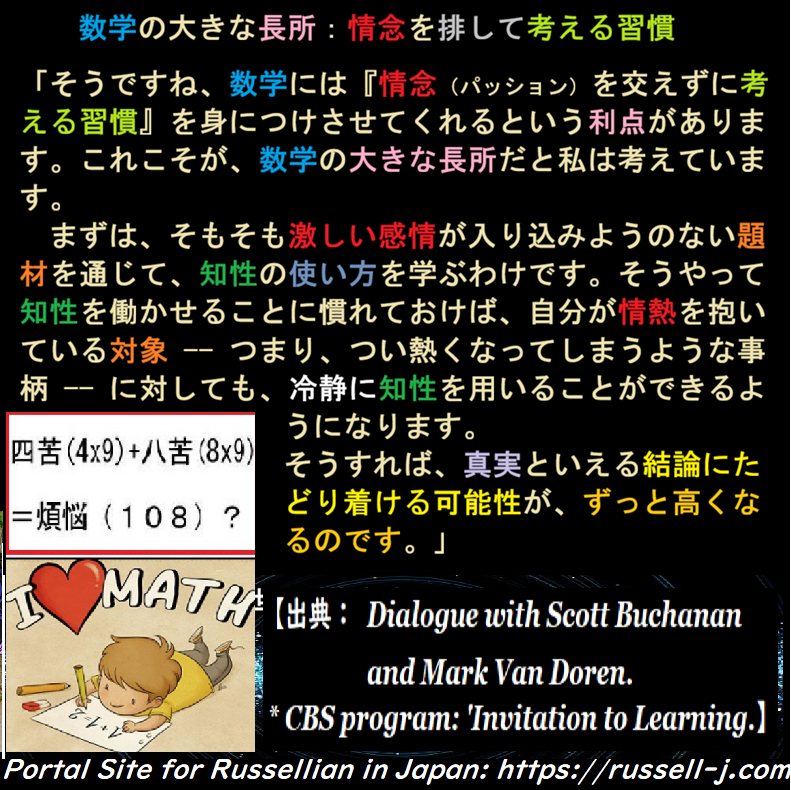
数学の大きな長所:情念を排して考える習慣
「そうですね、数学には『情念(パッション)を交えずに考える習慣』を身につけさせてくれるという利点があります。これこそが、数学の大きな長所だと私は考えています。
まずは、そもそも激しい感情が入り込みようのない題材を通じて、知性の使い方を学ぶわけです。そうやって知性を働かせることに慣れておけば、自分が情熱を抱いている対象 -- つまり、つい熱くなってしまうような事柄 -- に対しても、冷静に(パッションに流されずに)知性を用いることができるようになります。
そうすれば、真実といえる結論にたどり着ける可能性が、ずっと高くなるのです。」
The Great Merit of Mathematics: The Habit of Thinking Without Passion
Well, I think mathematics has the advantage of teaching you the habit of thinking without passion. That seems to me the great merit of mathematics. You learn to use your mind primarily upon material where passion doesn't come in, and having trained it in that way you can then use it passionlessly upon matters about which you feel passionately. Then you're much more likely to come to true conclusions.
Source: Spinoza's Ethics, 1942. - Spinoza's Ethics; dialogue with Scott Buchanan and Mark Van Doren. - * CBS program: 'Invitation to Learning.
<寸言:数学の大きな長所:情念を排して考える習慣>
数学について、みなさんはどのような理解や感情をお持ちでしょうか。数学的思考や論理的思考を好む人もいれば、数学が苦手な人や、中には嫌いだという人もいるでしょう。私自身は、小学校の高学年から数学が好きで、高校1年まではかなりよい成績をとっていました。
しかし、高校1年生の時にバートランド・ラッセルを知り、転機が訪れます。「ラッセルの著書をできるだけ幅広く読みたい」「彼のような幅広い知識や見識を持ちたい」という思いが募り、ラッセルに限らず、あらゆる分野の本を読み漁る多読生活に入っていきました。その結果、数学の勉強をまともにしなくなり、皮肉なことに、数学は好きなのに成績はどんどん下がっていってしまいました。
まさに「覆水盆に返らず」です。それはさておき、そのラッセルは1942年、米国のCBSの番組『New Invitation to Learning』に出演しました。その際、哲学者スピノザが、人間のドロドロとした感情や道徳の問題をあたかも図形のように幾何学的な手法で解き明かそうとした点に触れ、数学を学ぶ本当の利点について次のように述べています。
「そうですね、数学には『情念(パッション)を排して考える習慣』を身につけさせてくれるという利点があります。これこそが、数学の大きな長所だと私は考えています。非常に共感が持てる発言だと思いますが、みなさんはいかがでしょうか。
まずは、そもそも激しい感情が入り込みようのない題材を通じて、知性の使い方を学ぶわけです。そうやって知性を働かせることに慣れておけば、自分が情熱を抱いている対象??つまり、つい熱くなってしまうような事柄??に対しても、冷静に(パッションに流されずに)知性を用いることができるようになります。
そうすれば、真実といえる結論にたどり着ける可能性が、ずっと高くなるのです」
The Great Merit of Mathematics: The Habit of Thinking Without Passion
What kind of understanding or feelings do you have toward mathematics? Some people enjoy mathematical or logical thinking, while others find it difficult or even dislike it entirely. For my part, I have loved mathematics since the upper grades of elementary school and maintained excellent marks until my first year of high school.
However, a turning point came during that first year of high school when I discovered Bertrand Russell. Driven by a desire to read as many of his books as possible and to acquire the same kind of broad knowledge and insight he possessed, I immersed myself in a life of extensive reading -- not just Russell's works, but books from every imaginable field. As a result, I stopped studying mathematics properly. Ironically, although I still loved the subject, my test scores plummeted.
As they say, "there is no use crying over spilt milk." That aside, in 1942, Russell appeared on the CBS program New Invitation to Learning. During the broadcast, he touched upon how the philosopher Spinoza attempted to unravel the complexities of human emotion and morality through a geometrical method -- treating them as if they were lines and planes. Regarding the true benefit of learning mathematics in this context, Russell remarked:
"Well, I think mathematics has the advantage of teaching you the habit of thinking without passion. That seems to me the great merit of mathematics. You learn to use your mind primarily upon material where passion doesn't come in, and having trained it in that way you can then use it passionlessly upon matters about which you feel passionately. Then you're much more likely to come to true conclusions."I find this to be a deeply resonant statement. What do you all think?
 ラッセル関係電子書籍一覧 |
 ラッセル関係電子書籍一覧
#バートランド・ラッセル #Bertrand_Russell