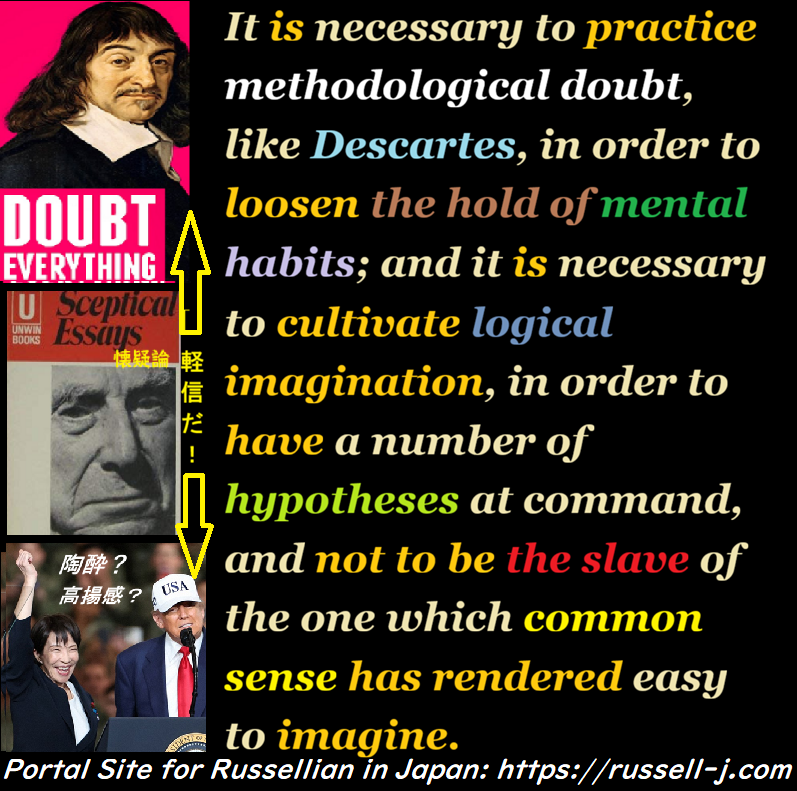
Source: Bertrand Russell: Our Knowledge of the External World, 1914, p.184
Short Comment: The Indivisibility of "Cartesian Methodological Doubt" and "Logical Imagination"
What Russell advocates here is not the conclusiveness of Cartesian doubt in itself (i.e., Cogito, ergo sum). Rather, he emphasizes the importance of making two seemingly opposite processes work simultaneously and complementarily: "methodological doubt" to loosen the hold of mental habits, and "logical imagination" to avoid becoming a slave to common sense.
To put it metaphorically: this bidirectional movement -- creating gaps in existing frameworks by "doubting the familiar" and then casting new hypotheses into those gaps by "imagining the unfamiliar" -- is the very core of what Russell calls philosophical training.
As Professor Emeritus Ayumi Yasutomi (University of Tokyo) argues in the quotation below, Russell was extremely critical of Descartes' logical conclusion (Cogito, ergo sum), viewing the proof of the "self" as a substantial entity as a logical leap. However, the reason Russell affirmatively invokes Descartes' method in today's passage is that he believed it becomes a powerful weapon for liberating the intellect from dogma only when combined with "logical imagination."
If one remains stuck in a doubt that presupposes the "self" as a subject, there is a danger of falling into nihilism, as Professor Yasutomi points out. This is precisely why Russell juxtaposed the "imagination" -- the power to continually construct multiple possibilities through logic -- with the vacuum created by doubt, as an essential requirement for a philosopher.
For reference, the following is an excerpt from Ayumi Yasutomi’s “The Academic Elite Run Amok” (Kodansha, June 2013 / Kodansha +α Shinsho 599-2c), as featured in "Russell Gleanings (1917)":
(Yasutomi): "This is a corrupted form of 'methodological skepticism.' This idea originally came from Descartes, who said, 'No matter how skeptical one becomes, the fact that there is a "me" who is doubting is the one thing that cannot be doubted.'
However, about 100 years ago, a philosopher named Bertrand Russell proved that such an idea is untenable. Simply put, he argued: 'If you become thoroughly skeptical, all that remains is the fact of the doubting itself (Note: a phenomenon within the brain); the subject known as "I" is nowhere to be found. Do not make the arbitrary leap of saying "There is an I who is doubting."' Without the subject called 'I,' there can be no certain knowledge, so methodological doubt fails to provide a path to certainty and instead collapses into nihilism.
Through this sharp critique, the blunt reality that 'methodological skepticism does not hold up' was proven. Despite this, a form of nihilism masquerading as methodological skepticism continues to persist to this day."
 ラッセル関係電子書籍一覧 |
 ラッセル関係電子書籍一覧
#バートランド・ラッセル #Bertrand_Russell