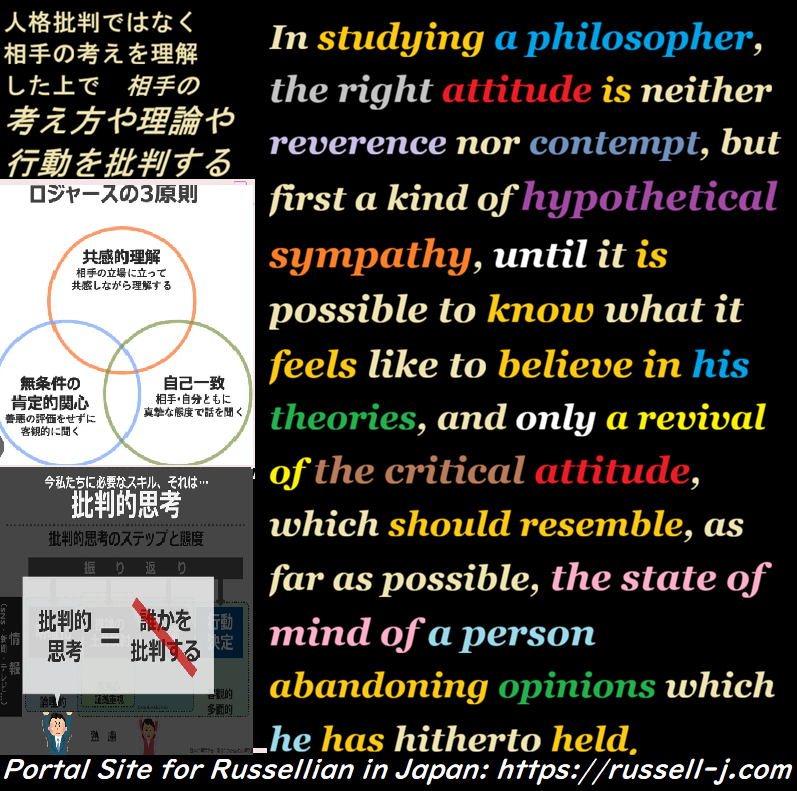
In studying a philosopher, the right attitude is neither reverence nor contempt, but first a kind of hypothetical sympathy, until it is possible to know what it feels like to believe in his theories, and only a revival of the critical attitude, which should resemble, as far as possible, the state of mind of a person abandoning opinions which he has hitherto held.
Source: Source: A History of Western Philosophy, 1945.
Brief Comment
Understanding the thoughts and feelings of others is an extremely difficult task. Most people are implicitly aware of this, and in practice society functions reasonably well even when mutual understanding remains shallow. If even ordinary citizens, who do not hold particularly profound ideas, find it hard to understand one another, then it is fair to say that understanding the thought of a philosopher of world stature as a whole is almost impossible.
Nevertheless, when we encounter passages in a philosopher's writings with which we strongly sympathize, we are easily tempted to believe that we have thereby understood the philosopher himself. This tendency seems especially common among younger readers.
Even so, Bertrand Russell, fully aware of these difficulties, offers the following advice concerning what he calls "the right attitude in studying a philosopher":
In studying a philosopher, the right attitude is neither reverence nor contempt, but first a kind of hypothetical sympathy, until it is possible to know what it feels like to believe in his theories, and only then a revival of the critical attitude, which should resemble, as far as possible, the state of mind of a person abandoning opinions which he has hitherto held.This is truly an attitude that is "easier said than done." Yet it was precisely because Russell himself practiced this attitude that, in his great work A History of Western Philosophy (1945), he was able to demonstrate both a deep understanding of many philosophers of the past and a keen critical judgment of their ideas. More than that, he succeeded in enabling his readers to understand those philosophers and even to feel a degree of sympathy with them.
Albert Einstein, too, spoke in the highest terms of praise for Russell's A History of Western Philosophy, emphasizing Russell's freshness, originality, and remarkable capacity for imaginative sympathy with distant ages and alien modes of thought, and regarding the book as an outstandingly educational work that rises above partisan conflicts of opinions.
A History of Western Philosophy was originally written at the request of Dr. Albert C. Barnes, the founder of the Barnes Foundation, for a series of public lectures intended for general audiences. Accordingly, the book is written in a style accessible to ordinary readers, and in many places Russell deliberately adopts extreme or provocative formulations in order to engage and delight his listeners and readers.
Some critics have disliked this aspect of the book and have objected that it lacks philosophical depth. One such critic was Tatsuo Hayashi, well known as the editor-in-chief of Heibonsha's Encyclopedia of World Knowledge. Yet it may well be argued that this very manner of presentation, consciously chosen by Russell, is what made it possible for him to present the history of philosophy not as a mere catalogue of doctrines, but as a living history of human thought.
 ラッセル関係電子書籍一覧 |
 ラッセル関係電子書籍一覧
#Bertrand_Russell