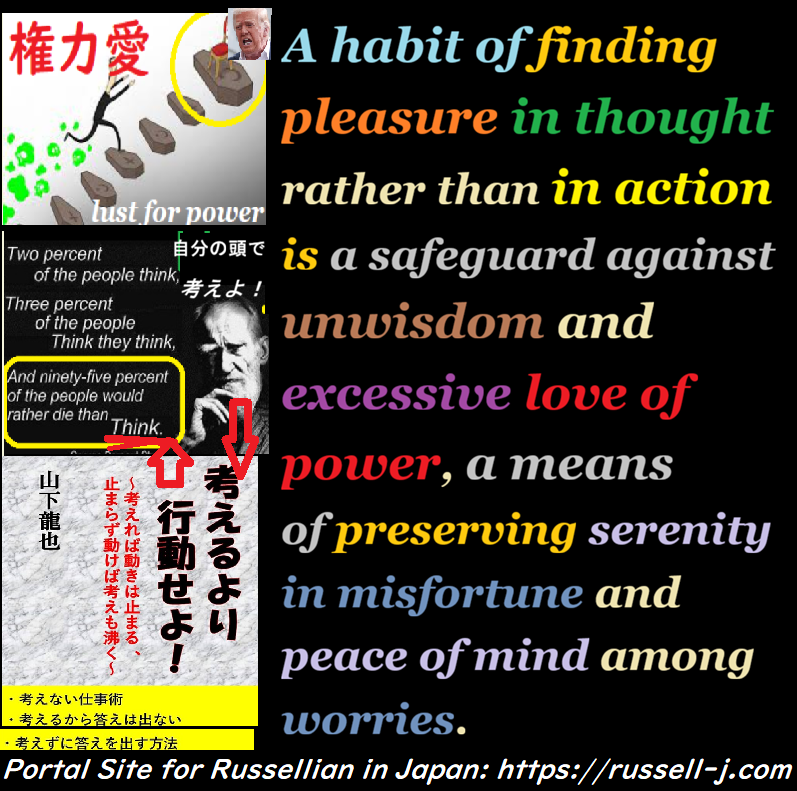
A habit of finding pleasure in thought rather than in action is a safeguard against unwisdom and excessive love of power, a means of preserving serenity in misfortune and peace of mind among worries.
Source: "Useless" Knowledge
First published as "Social Importance of Culture" in The Sunday Referee, 8 Oct. 1933, and reprinted In Praise of Idleness, and Other Essays,1935,
Brief Comment
Thought and action are like the two wheels of a car; if one is missing, it would be like driving with one foot, which is dangerous. Action without thought, or thought without action, are both incomplete. Philosophically, some argue that thought alone has value, but expressing one's thoughts is also a form of “action” in a broad sense. Both are important. Only when both wheels function together can the car move smoothly. If one is missing, unless you are a professional driver, the risk of derailing increases.
However, depending on the situation or mood, people often emphasize either thought or action. Russell was no exception. In 1935, on the eve of World War II, his words emphasized the importance of “thinking for oneself” at a time when the world was moving toward war?a large-scale act.
Prime Minister Takaichi, for her part, urges herself on by repeating, “Work, work, work,” but to me this attitude seems somehow lacking in solid grounding. At the same time, given her unusually high level of public support, there is a risk that she may run out of control, driven by that support. Might it be that Prime Minister Takaichi and the public are sharing the same bed while dreaming different dreams?
 ラッセル関係電子書籍一覧 |
 ラッセル関係電子書籍一覧
#Bertrand_Russell