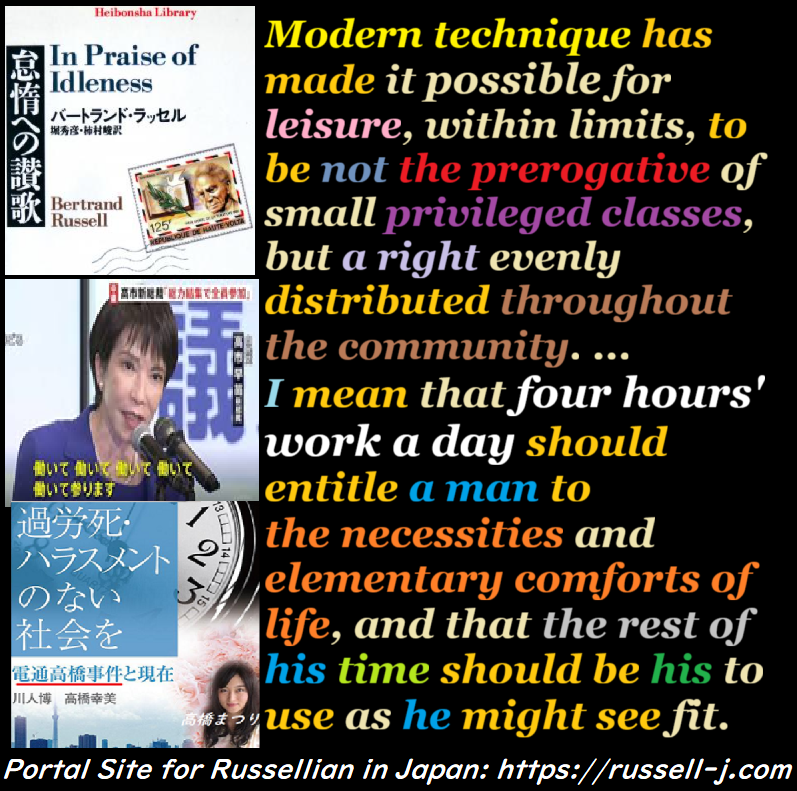
Modern technique has made it possible for leisure, within limits, to be not the prerogative of small privileged classes, but a right evenly distributed throughout the community. ...
... I mean that four hours' work a day should entitle a man to the necessities and elementary comforts of life, and that the rest of his time should be his to use as he might see fit.
Source: Bertrand Russell : In Praise of Idleness, 1935, chap.1.
More info.: https://russell-j.com/beginner/LEISURE.HTM
* a brief comment:
Russell, in his 1935 book In Praise of Idleness, argues that the amount of work imposed by organizations -- such as companies and government offices -- need be (need to be) no more than four hours a day, and that the remaining time should be left for individuals to use freely. Of course, what can be secured by those four hours is only the "right to obtain the necessities and elementary comforts of life." Consequently, some people would choose to work more than eight hours in pursuit of greater material comfort, while others might devote themselves to scholarship or the arts; the ways in which people make use of their leisure would naturally vary widely from person to person.
In this book, Russell sets forth an idea corresponding to what is now called a basic income -- what he himself referred to as a "vagabond wage." In recent years, political parties -- such as the Sansei Party -- have begun to advocate basic income as a policy, but the idea is by no means new; Russell had already proposed it as early as the 1930s.
This essay was written with the intention of countering the darkening international climate on the eve of the Second World War. In 1932, Japan installed Puyi, the last emperor of the Qing dynasty, as the figurehead of the newly founded state of Manchukuo; on January 30, 1933, Hitler became Chancellor of Germany; and in 1934 the Soviet Union began its large-scale purges.
Russell maintains that if every citizen were to work four hours a day, and socially useful work were fairly distributed so as to eliminate unemployment, then -- even with the level of science and technology available at the time -- it should be entirely possible to create a society in which almost everyone enjoys "the necessities and elementary comforts of life."
Of course, in today's world, where nations are deeply interconnected, this is not a problem that can be solved by eliminating inequality within a single country. Inequalities must be reduced on a global scale. Whether this will take a hundred or two hundred years is unknown, but Russell believed that, so long as humanity does not perish in a nuclear war, this ideal remains "possible" of realization. Whether human beings will choose such a path, however, is another matter.
 ラッセル関係電子書籍一覧
#Bertrand_Russell
... I mean that four hours' work a day should entitle a man to the necessities and elementary comforts of life, and that the rest of his time should be his to use as he might see fit.
Source: Bertrand Russell : In Praise of Idleness, 1935, chap.1.
More info.: https://russell-j.com/beginner/LEISURE.HTM
* a brief comment:
Russell, in his 1935 book In Praise of Idleness, argues that the amount of work imposed by organizations -- such as companies and government offices -- need be (need to be) no more than four hours a day, and that the remaining time should be left for individuals to use freely. Of course, what can be secured by those four hours is only the "right to obtain the necessities and elementary comforts of life." Consequently, some people would choose to work more than eight hours in pursuit of greater material comfort, while others might devote themselves to scholarship or the arts; the ways in which people make use of their leisure would naturally vary widely from person to person.
In this book, Russell sets forth an idea corresponding to what is now called a basic income -- what he himself referred to as a "vagabond wage." In recent years, political parties -- such as the Sansei Party -- have begun to advocate basic income as a policy, but the idea is by no means new; Russell had already proposed it as early as the 1930s.
This essay was written with the intention of countering the darkening international climate on the eve of the Second World War. In 1932, Japan installed Puyi, the last emperor of the Qing dynasty, as the figurehead of the newly founded state of Manchukuo; on January 30, 1933, Hitler became Chancellor of Germany; and in 1934 the Soviet Union began its large-scale purges.
Russell maintains that if every citizen were to work four hours a day, and socially useful work were fairly distributed so as to eliminate unemployment, then -- even with the level of science and technology available at the time -- it should be entirely possible to create a society in which almost everyone enjoys "the necessities and elementary comforts of life."
Of course, in today's world, where nations are deeply interconnected, this is not a problem that can be solved by eliminating inequality within a single country. Inequalities must be reduced on a global scale. Whether this will take a hundred or two hundred years is unknown, but Russell believed that, so long as humanity does not perish in a nuclear war, this ideal remains "possible" of realization. Whether human beings will choose such a path, however, is another matter.
 ラッセル関係電子書籍一覧 |
ラッセル関係電子書籍一覧
#Bertrand_Russell