
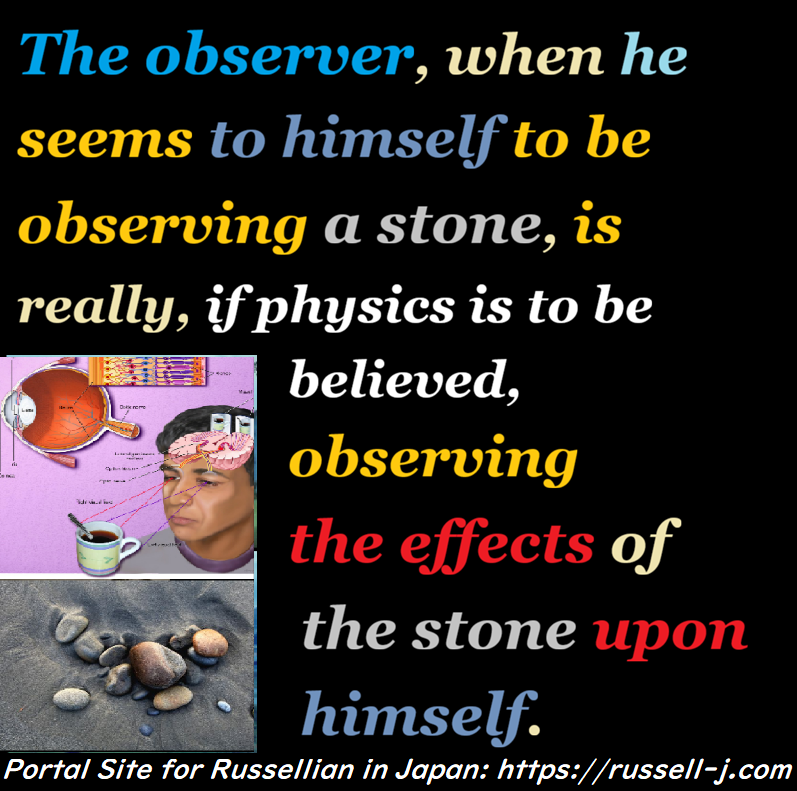
The observer, when he seems to himself to be observing a stone, is really, if physics is to be believed, observing the effects of the stone upon himself.
Source: Bertrand Russell: An Inquiry into Meaning and Truth ,1940, Introduction, p. 15
Russell's Stone and the Uncertainty of "Seeing": Why Is Mutual Understanding So Difficult?
1. Understanding What Others Are Saying
The functions of human sense organs are, under normal conditions, more or less the same for everyone. However, even when observing the same objects or receiving the same information, people perceive and interpret them differently.
Therefore, in situations where accurately understanding what someone else is saying is crucial, we strive to grasp the meaning and nuances of their words. Yet, when it comes to politicians we do not know personally (for example, Donald Trump or Sanae Takaichi), our understanding often remains superficial. The speakers themselves tend to believe that their own words are simple and should be easily understood if listened to in good faith, which illustrates just how difficult true mutual understanding can be.
2. Are We Really Seeing the "Stone"?
Scientific observation faces similar difficulties. In the Introduction to An Inquiry into Meaning and Truth (1940), Bertrand Russell points out the following:
"The observer, when he seems to himself to be observing a stone, is really, if physics is to be believed, observing the effects of the stone upon himself." (Source: Bertrand Russell: An Inquiry into Meaning and Truth, 1940, Introduction, p. 15)One might think this is merely stating a common-sense fact. In everyday life, it is generally harmless to assume that we are "directly" observing external objects. However, we often forget that we are, in fact, observing only the phenomena generated within our own nervous systems. The same applies to our interactions with politicians. Their words do not reach us directly; we are merely perceiving an "interpretation" created within our own brains. Simply becoming aware of this fact can change the way we understand others.
3. The Cage of "Human-Centric" Perception
We should, as much as possible, try to reflect on the fact that what we see when observing the external world is not the event itself, but the "effects" (the consequences and impacts) of the stimuli reaching our brains via our optic nerves and causing neural phenomena. If we can maintain this perspective, we should be far less likely to be misled or deceived.
Human society is designed based on average human sensory capabilities. Within this framework, individuals with, say, a sense of smell like a dog’s or vision like a hawk’s (or a dragonfly’s) might find it difficult to navigate. We are prone to the misconception that this world is conveniently constructed to suit our human sense organs. Even "God" is often imagined in a way that is convenient for humans. We must occasionally remind ourselves that the world we "see" is merely a worldview constructed by the human species and its specific sensory apparatus.
 ラッセル関係電子書籍一覧 |
 ラッセル関係電子書籍一覧
#バートランド・ラッセル #Bertrand_Russell