The Illusion of "Racial Purity": Russell's Warning and Modern Japan
In his 1943 essay, An Outline of Intellectual Rubbish, Bertrand Russell exposed the fallacies of racial theory with his characteristic sharp wit:
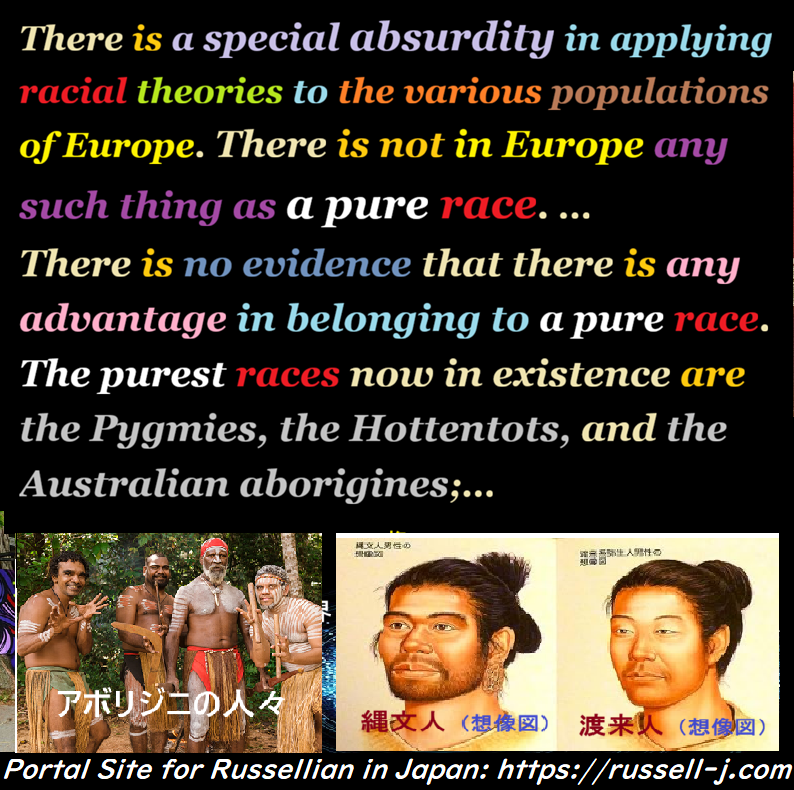
"There is a special absurdity in applying racial theories to the various populations of Europe. There is not in Europe any such thing as a pure race. ... There is no evidence that there is any advantage in belonging to a pure race. The purest races now in existence are the Pygmies, the Hottentots, and the Australian aborigines. ...Re-evaluating "Purity" in the Japanese Context
The ancient Greeks, on the other hand, emerged from an amalgamation of northern barbarians and an indigenous population; the Athenians and Ionians, who were the most civilized, were also the most mixed. The supposed merits of racial purity are, it would seem, wholly imaginary."
Living in an island nation, it is often claimed that the Japanese people possess a higher degree of racial purity compared to other ethnic groups. However, such "purity" is merely relative. When we examine the historical and scientific facts, the following points must be considered:
1. The "Triple-Structure" Genomic Model: According to the latest whole-genome analyses, modern Japanese are not just a mix of hunter-gatherer "Jomon" and rice-farming "Yayoi" migrants. A "triple-structure" model has become the mainstream theory, identifying a third significant influx of "Kofun" migrants from the Asian continent during the 3rd to 7th centuries.
2. Land Bridges during the Ice Age: While the Japanese archipelago separated from the mainland approximately 15 million years ago, it became reconnected to the Chinese mainland and the Korean Peninsula via land bridges during various glacial periods (notably during the Last Glacial Maximum about 20,000 years ago) due to falling sea levels.
3. A History of Continuous Influx and Admixture: Until the end of the last glacial period (roughly 10,000 to 12,000 years ago) -- and even thereafter -- the archipelago was not an isolated "pure laboratory." It was a site of constant genetic and cultural influx.
Conclusion
It is worth noting that the groups Russell cites as "pure" -- such as the Pygmies and Australian Aborigines -- remained so precisely because they were physically isolated from outside contact for vast periods. In contrast, the fact that the civilization of Ancient Greece was built by "the most mixed" people eloquently demonstrates that "purity" is no guarantee of cultural or intellectual excellence.
Given these facts, anyone asserting the "purity" of the Japanese race should be asked how they interpret these scientific and historical realities. To avoid falling into narrow-minded nationalism, we must look beyond the imaginary phantom of "purity" and recognize that our unique culture was forged through the very process of admixture and integration.
 ラッセル関係電子書籍一覧 |
 ラッセル関係電子書籍一覧
#バートランド・ラッセル #Bertrand_Russell