Majority Rule or the Reflection of Diversity? Rethinking the "Proper Functioning of Democracy" with Bertrand Russell
In the recent general election held on February 8, 2026, Sanae Takaichi was re-elected as the Prime Minister of Japan through "democratic procedures." Under Japan’s parliamentary cabinet system, the leader is elected by the Diet -- specifically the House of Representatives. With the Liberal Democratic Party (198 seats), Ishin (34), and the Democratic Party for the People (27) forming a coalition, they command 259 seats, exceeding the 233 required for a majority. Constitutionally, Ms. Takaichi's position was already secure; there was no inherent need for an election to "ask ask the public whether she should lead as Prime Minister.
However, in a sudden reversal, Ms. Takaichi declared she would "seek a mandate from the people" and dissolved the House of Representatives at the very start of the session. While a dissolution to test public sentiment after a period of governing is understandable, dissolving the Diet after bypassing parliamentary debate and allowing a mere 16-day campaign period is nothing short of an affront to the democratic process. It was a reckless move aimed at resetting the political landscape through the sheer force of numbers, without providing the public with sufficient information to judge her.
This is particularly troubling given that inconvenient reports regarding Ms. Takaichi were beginning to emerge in publications like Shukan Bunshun just before the dissolution. The suspicion that this was a "tactical dissolution" to evade accountability remains potent. Yet, as the LDP secured an overwhelming majority, the media and the public -- who initially decried the move as a "dissolution without cause"-- have largely fallen silent. There is a dangerous trend where electoral victory is treated as a form of "absolution," purifying any coercive methods used to achieve it.
Periodic elections are essential for democracy. But was the roughly 80 billion yen spent on this election -- held only a year and a half after the last one-- justified for a dissolution that effectively buried lingering scandals in a shroud of electoral numbers?
A healthy democracy requires "diversity within society." However, leaders like Donald Trump in the U.S. and Sanae Takaichi in Japan seem not only to ignore but to marginalize diversity within the political sphere, showing a marked disregard for the existence of dissenting voices.
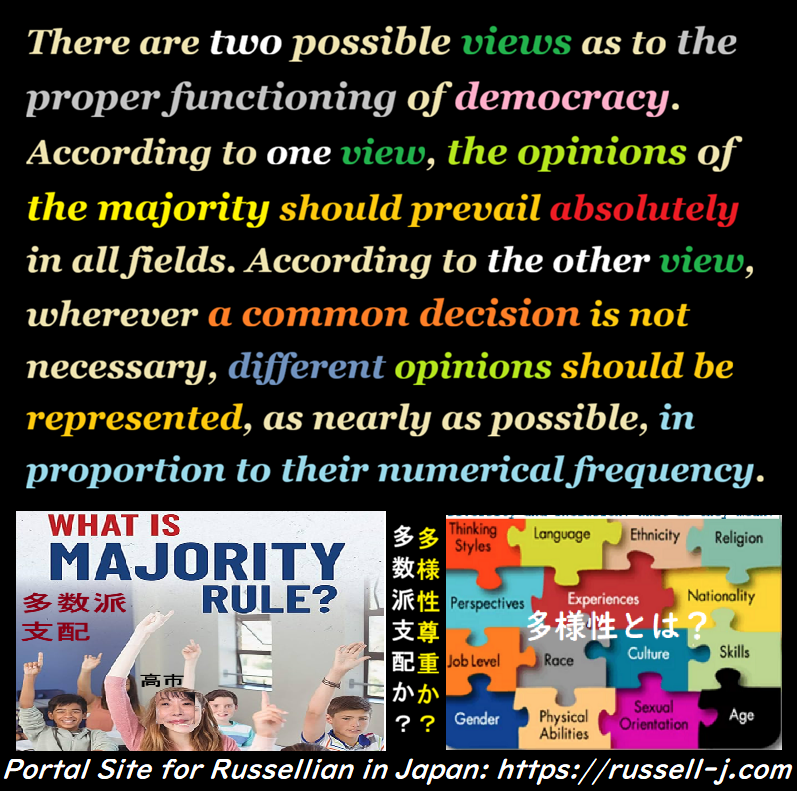
In his essay "Freedom and the Colleges" (1940), found in Why I Am Not a Christian and Other Essays on Religion and Related Subjects, the philosopher Bertrand Russell presents two distinct views on democracy that we must not confuse:
"There are two possible views as to the proper functioning of democracy. According to one view, the opinions of the majority should prevail absolutely in all fields. According to the other view, wherever a common decision is not necessary, different opinions should be represented, as nearly as possible, in proportion to their numerical frequency."The "overwhelming majority" Ms. Takaichi secured may be a powerful tool for forming a "common decision" in administration. However, if that numerical strength is used as a shield to silence dissent and dye every facet of society in the colors of the majority, it steps into what Russell feared: the first view, or the tyranny of the majority.
Winning an election does not grant a mandate to eliminate minority opinions or inconvenient criticism. We must return to Russell's words and ask ourselves once more: what does it truly mean for democracy to "function properly"?
 ラッセル関係電子書籍一覧 |
 ラッセル関係電子書籍一覧
#バートランド・ラッセル #Bertrand_Russell