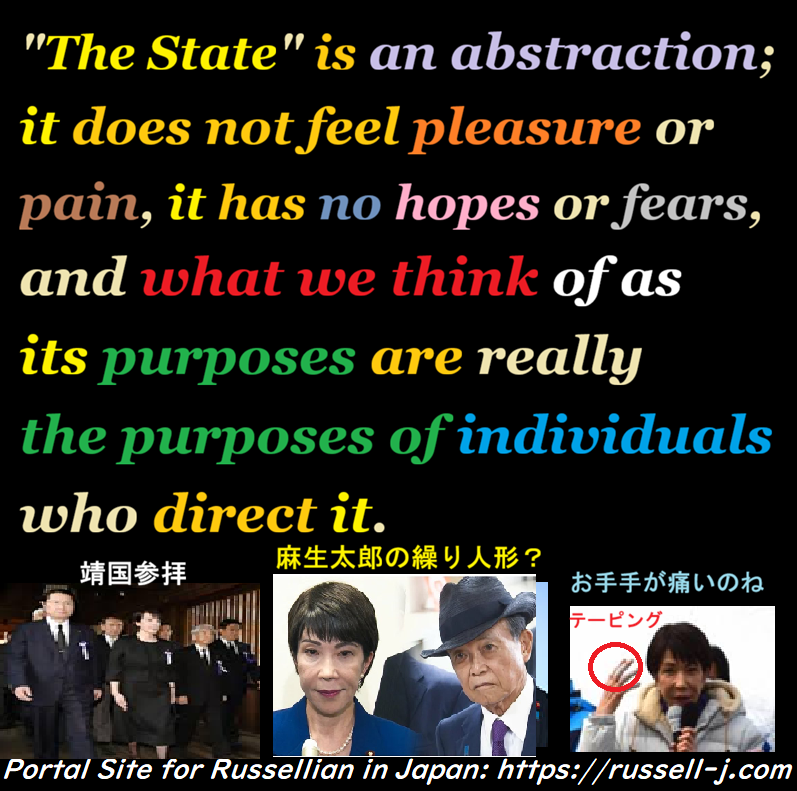
"The State" is an abstraction
"The State" is an abstraction; it does not feel pleasure or pain, it has no hopes or fears, and what we think of as its purposes are really the purposes of individuals who direct it.
Short Essay: The True Nature of the Abstraction Called "Protecting the Nation"
In one of his lectures (collected in Authority and the Individual, 1949), Bertrand Russell asserted that "the State" is merely an abstraction; it feels neither pleasure nor pain. He pierced through the illusion by stating that what we believe to be the purposes of the State are, in reality, the purposes of the individuals who direct it. From this perspective, it is necessary to analyze the phrase "protecting the nation," a term frequently brandished by modern politicians.
King Louis XIV of France is famously attributed with the saying, "L'Etat, c'est moi" (I am the State). In his era, "protecting the nation" was literally synonymous with "protecting the King" (the ruler). In modern Japan, very few would openly claim that protecting the nation means protecting the Emperor. Yet, many politicians incessantly repeat the phrase "protecting the nation." If their meaning were truly identical to "protecting the lives of the citizens," it should suffice to say "protecting the people" without resorting to the word "nation." However, they do not. In many cases, they intentionally conflate "protecting the people" with "protecting the nation," leaving the meaning of the latter conveniently ambiguous.
There is a symbolic scene often observed: cabinet ministers frequently bowing to the national flag just before a press conference. To what, exactly, are they bowing? It is hard not to see this as a way of justifying their own authority by saluting an "abstraction" in the form of a piece of cloth. It is difficult to believe that any genuine respect for the "living, breathing citizens" exists in that gesture.
Behind the phrase "protecting the nation," various nuances coexist depending on the speaker: "protecting the existing regime," "protecting the lives of Japanese citizens," "protecting democracy," or "protecting freedom." While private citizens without power are free to hold whatever illusions they wish, the matter changes entirely for politicians who hold the authority to mobilize the Self-Defense Forces.
Politicians who recklessly declare that "a Taiwan contingency is a Japan contingency" and advocate for military action in coordination with U.S. forces are dangerously unsettling. We must be especially wary of politicians like Sanae Takaichi, who seem to prefer "strong" rhetoric and emotional posturing over logical consistency. When such politicians venerate and glorify the war dead as "Eirei" (heroic spirits), one can see right through to the "glorification of an abstraction" that Russell pointed out. By sanctifying concrete individual sacrifices and substituting them with a beautiful national narrative, they may be operating under a cold-blooded calculation: that a certain amount of sacrifice by the citizens is inevitable to maintain the current conservative regime.
Yet, there is an ironic reality. These individuals, who pose as "conductors" manipulating the abstraction of the State, are themselves being appraised by another massive will -- that of their ally, the United States. For better or worse, it is rumored that a growing number of people within the U.S. believe that figures like Ms. Takaichi should be removed from power sooner rather than later.
Whom and what are they trying to protect with the hollow word "nation"? We must use Russell’s cold realism as a weapon to keep a watchful eye on what lies behind the words of our politicians. Or is my perspective merely an illusion?
 ラッセル関係電子書籍一覧 |
 ラッセル関係電子書籍一覧
#バートランド・ラッセル #Bertrand_Russell