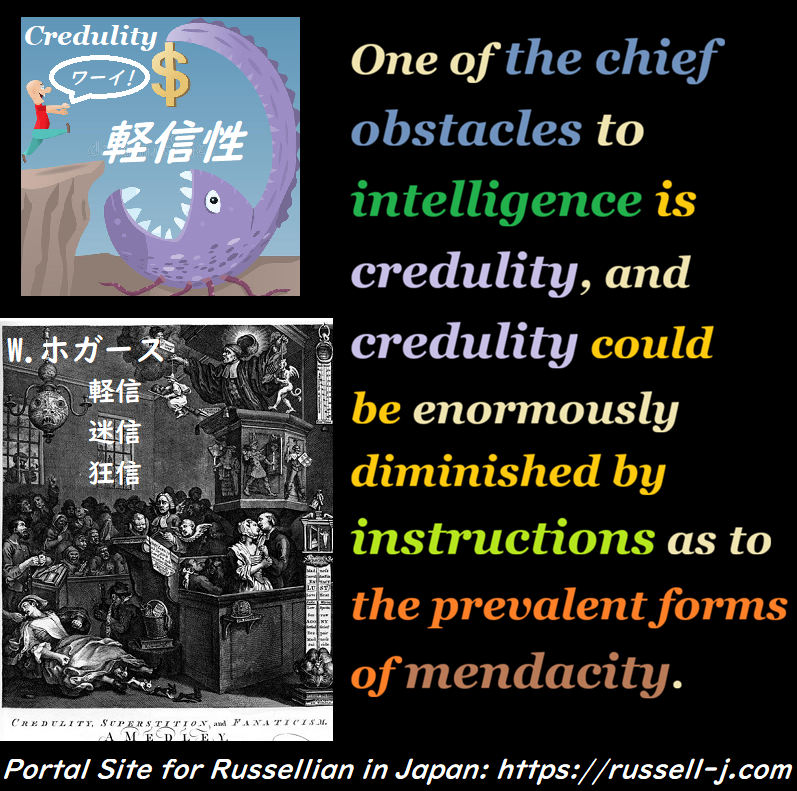
Bertrand Russell: Free Thought and Official Propaganda, 1922, p.52. Reprinted in: Sceptical Essays, 1928, chapter 12.
Short Essay: Education for Developing Thinking Skills ? Analyzing the "Rhetorical Forms of Language"
One of the chief obstacles to intelligence is credulity (the tendency to believe things too easily without evidence). Bertrand Russell argued that this credulity could be enormously diminished by providing instruction on the prevalent "rhetorical forms of language" used to convey falsehoods.
While we often use the terms "lies" and "deception" interchangeably, there is a strategic nuance between them that we must distinguish:
Lies: Simple factual inaccuracies or blatant falsehoods.
Deception (Mendacity): A deeper form of manipulation where one’s attitude or framing makes oneself appear more credible or virtuous than the reality suggests.
As we approach the "Future Investment Dissolution" general election on February 8th, the current political climate under Prime Minister Takaichi serves as a critical "textbook" for testing our collective intelligence.
Case Analysis: Examining the "Rhetorical Forms" of PM Takaichi
01: Rhetoric of Counterfeit Authority (The Congressional Fellow Issue) For years, her official profile listed her as a "Congressional Investigator." In reality, she was a "Congressional Fellow" (trainee) from the Matsushita Institute. By borrowing the rhetorical form of a professional title, she instilled an exaggerated sense of authority in the public mind. This is a classic example of what Russell warned against: deception through formal framing.
02: Rhetoric of Categorical Denial (The Broadcasting Act "Fabrication" Case) Her definitive assertion that internal Ministry of Internal Affairs documents were "fabrications" is a key example. By using a powerful rhetorical form to label and dismiss opposition before a factual verification could occur, she effectively halts the audience’s critical thinking, inducing them to believe in her own legitimacy.
03: Rhetoric of Concealing Inconsistency (Taiwan Emergency & Yasukuni Visits, 2025) Her November 2025 remarks suggesting military intervention in a Taiwan emergency, followed by a later clarification that it was "within government policy," show a pattern of shifting. Similarly, her campaign pledge to visit the Yasukuni Shrine evolved into the ambiguous rhetorical form of "making an appropriate judgment" after taking office. These acts use language to mask the gap between personal conviction and political reality.
04: Rhetoric of Evoking Expectation (January 2026 "Future Investment Dissolution") The naming of the current dissolution as "Future Investment" is a highly sophisticated rhetorical maneuver. By rebranding the election with the positive rhetorical form of "the future," she attempts to reset and obscure past criticisms?such as the abandonment of tax-free food pledges?and entice the public back into a state of "credulity."
Conclusion
To compare what was said in the past with what is being said now?stripping away the decorative rhetoric?is the fundamental basis of logical thinking. Developing the habit of scrutinizing these informational discrepancies using historical records is the only true education that can protect us from modern propaganda.
On February 8th, will we vote for the "sound of words," or the "accumulation of facts"? Russell’s sharp warning has never resonated more deeply than it does today.
 ラッセル関係電子書籍一覧 |
 ラッセル関係電子書籍一覧
#バートランド・ラッセル #Bertrand_Russell