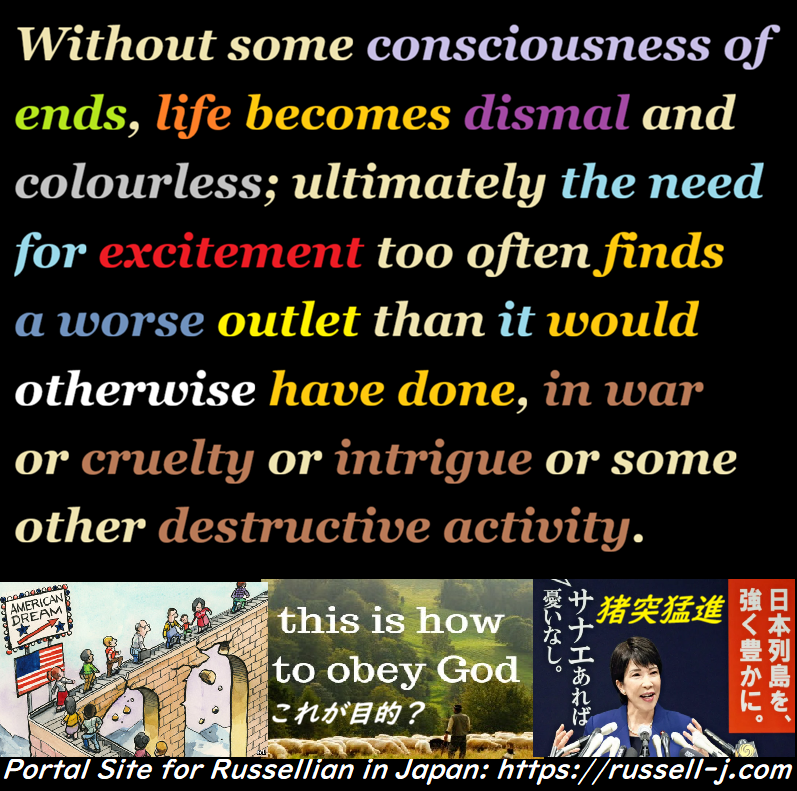
Without some consciousness of ends, life becomes dismal and colourless; ultimately the need for excitement too often finds a worse outlet than it would otherwise have done, in war or cruelty or intrigue or some other destructive activity.
Source: Bertrand Russell: The Conquest of Happiness, 1930, chapter 4
Brief Comment
If a person has a life work that they can pursue with interest and passion throughout their life, it provides their life with consistency and meaning. On the other hand, if a person does not have some form of purpose, they are likely to engage in actions seeking excitement in order to make their daily life enjoyable or stimulating.
Without a sense of purpose, one will not be treated as a full-fledged adult, nor as a student, and certainly not as a politician. However, this sense of purpose does not always have a positive effect.
Humans fear boredom and many seek constant stimulation and excitement. Could this be the result of primitive instincts that still influence us? Of course, there are those whose only purpose in life is to watch their grandchildren grow, leading a peaceful life without seeking further excitement or stimulation. However, even as they age, it is only natural for people who are fortunate enough to retain the vitality of their 40s or 50s to find a more diverse range of positive outlets. Unfortunately, in reality, many people, as Russell suggests in the following words, find bad outlets instead:
"Wars, pogroms, and persecutions have all been part of the flight from boredom; even quarrels with neighbours have been found better than nothing. Boredom is therefore a vital problem for the moralist, since at least half the sins of mankind are caused by the fear of it."
> Source: Bertrand Russell, The Conquest of Happiness (1930), Chapter 4: Boredom and Excitement.
 ラッセル関係電子書籍一覧 |
 ラッセル関係電子書籍一覧
#Bertrand_Russell