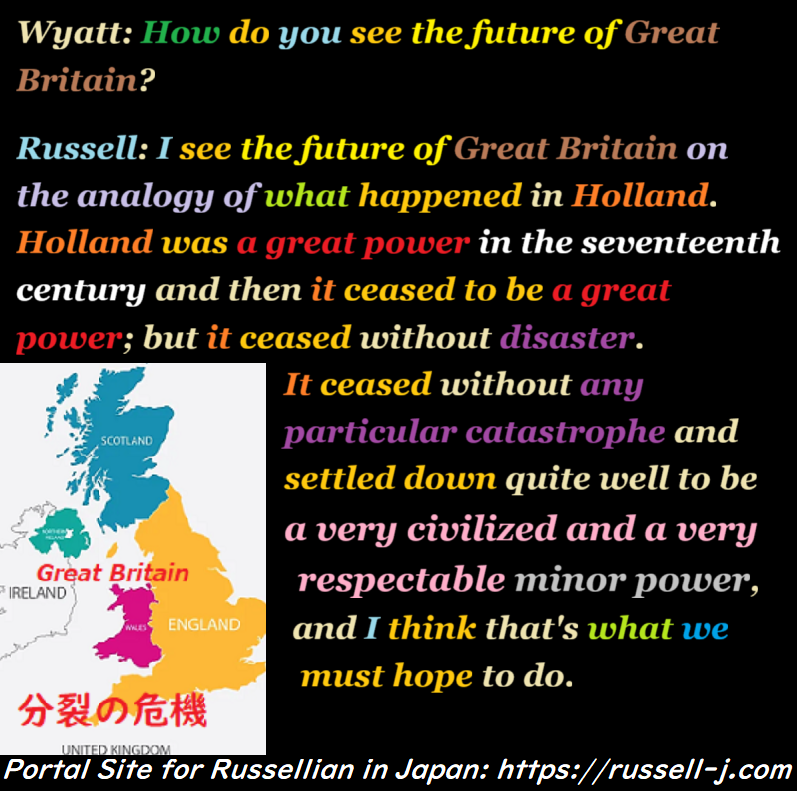
Wyatt: How do you see the future of Great Britain?
Russell: I see the future of Great Britain on the analogy of what happened in Holland. Holland was a great power in the seventeenth century and then it ceased to be a great power; but it ceased without disaster. It ceased without any particular catastrophe and settled down quite well to be a very civilized and a very respectable minor power, and I think that's what we must hope to do.
Source: Bertrand Russell Speaks His Mind, 1960, interview 11
* a brief comment:
Japan's Future and the Choice of Immigration Policy
Japan's population (currently about 130 million) is expected to decline due to a falling birthrate and an aging population. According to Cabinet Office estimates and other population forecasts, Japan's population could drop to around 50 million by the end of this century (2100). Estimates indicate that the population could fall within a range of 40 to 60 million. In other words, even with countermeasures against the declining birthrate, a significant population decrease is anticipated.
The focus is on immigration policy. As long as many foreign workers continue to come, the situation may remain manageable, but if Japan continues to maintain a reluctant attitude toward accepting immigrants, the number of workers coming to Japan will sharply decline, and the country may face a risk of societal and economic decline. The current Takai administration firmly asserts that it will not adopt a comprehensive immigration policy, and right-wing and conservative groups make similar claims in the name of protecting Japan's national identity. But how long can Japan continue this stance?
The Takaichi administration and conservative factions seem to aim at competing with China, securing the backing of the United States, and becoming a leading power in Asia while strengthening their military capabilities. However, this approach may lead to unfortunate consequences for Japan.
Instead, following the example of the United Kingdom, it seems wiser for Japan to take a leadership role in science, advanced technology, and culture, and to use these strengths to build a society where many people can prosper without creating significant inequality.
How do you think Japan should approach these challenges?
 ラッセル関係電子書籍一覧
#Bertrand_Russell
Russell: I see the future of Great Britain on the analogy of what happened in Holland. Holland was a great power in the seventeenth century and then it ceased to be a great power; but it ceased without disaster. It ceased without any particular catastrophe and settled down quite well to be a very civilized and a very respectable minor power, and I think that's what we must hope to do.
Source: Bertrand Russell Speaks His Mind, 1960, interview 11
* a brief comment:
Japan's Future and the Choice of Immigration Policy
Japan's population (currently about 130 million) is expected to decline due to a falling birthrate and an aging population. According to Cabinet Office estimates and other population forecasts, Japan's population could drop to around 50 million by the end of this century (2100). Estimates indicate that the population could fall within a range of 40 to 60 million. In other words, even with countermeasures against the declining birthrate, a significant population decrease is anticipated.
The focus is on immigration policy. As long as many foreign workers continue to come, the situation may remain manageable, but if Japan continues to maintain a reluctant attitude toward accepting immigrants, the number of workers coming to Japan will sharply decline, and the country may face a risk of societal and economic decline. The current Takai administration firmly asserts that it will not adopt a comprehensive immigration policy, and right-wing and conservative groups make similar claims in the name of protecting Japan's national identity. But how long can Japan continue this stance?
The Takaichi administration and conservative factions seem to aim at competing with China, securing the backing of the United States, and becoming a leading power in Asia while strengthening their military capabilities. However, this approach may lead to unfortunate consequences for Japan.
Instead, following the example of the United Kingdom, it seems wiser for Japan to take a leadership role in science, advanced technology, and culture, and to use these strengths to build a society where many people can prosper without creating significant inequality.
How do you think Japan should approach these challenges?
 ラッセル関係電子書籍一覧 |
ラッセル関係電子書籍一覧
#Bertrand_Russell